

ROS 2 - ZED Mono Node
ROS 2 - ZED Mono Node
The easiest way to start a ZED ROS 2 node for a monocular camera is by using the command line:
where <camera model> must be replaced with one of zedxonegs, zedxone4k, or zedxonecore.
Published Topics
The ZED node publishes data to the following topics:
-
Status
~/status/heartbeat: heartbeat signal to monitor if the node is alive from other nodes (custom message).~/status/svo: status of the SVO playback (only advertised when an SVO file is used as input).
-
Image streams
The image topic names are created using the following naming convention:
~/<sensor_type>/<color_model>/<rect_type>/imageStarting from version 5.1.0 of the ROS 2 Wrapper the new convention replaces the previous formats such as
~/<sensor_type>/image_<rect_type>_<color_model>and~/<sensor_type>_<rect_type>/image_<rect_type>_<color_model>(e.g.,~/left/image_rect_color,~/rgb_raw/image_raw_gray). Please update your launch files and scripts to use the new topic names.- RGB channel
~/rgb/color/rect/image: Color rectified image.~/rgb/color/rect/camera_info: Color camera calibration data.~/rgb/gray/rect/image: Grayscale rectified image.~/rgb/gray/rect/camera_info: Grayscale camera calibration data.~/rgb/color/raw/image: Color unrectified image.~/rgb/color/raw/camera_info: Color raw calibration data.~/rgb/gray/raw/image: Grayscale unrectified image.~/rgb/gray/raw/camera_info: Grayscale raw calibration data.
- RGB channel
Since v5.5.0 of the ROS 2 Wrapper the distortion_model and the distortion coefficients published in the camera_info topics are read from the ZED SDK (>= 5.4) instead of a hard-coded per-model table that the lens does not always follow: a fisheye ZED X One now reports equidistant instead of rational_polynomial. Rectified parameters are reported as plumb_bob with zero coefficients.
-
Sensors data
~/imu/data~/imu/data_raw~/temperature~/left_cam_imu_transform
Image Transport
The ROS 2 wrapper supports the stack image_transport introduced with ROS 2 Crystal Clemmys.
Starting from version 5.3 of the ROS 2 Wrapper, image messages are published through rclcpp::TypeAdapter for more efficient handling:
- The base
rawtopic is handled by aTypeAdapterpublisher. Intra-process subscribers (e.g., other nodes running in the same component container) receive aStampedSlMatobject — a wrapper around the nativesl::Mat— directly, without any serialization overhead. Inter-process subscribers transparently receive a standardsensor_msgs/msg/Imagemessage thanks to the automaticTypeAdapterconversion. - The transport-specific variants are handled by an
image_transportpublisher. Itsrawtransport is disabled to avoid publishing duplicate messages, since therawstream is already provided by theTypeAdapterpublisher described above.
To prevent silent data corruption caused by incompatible plugin/encoding combinations, the advertised image transports are filtered by topic type. Visual image topics (color and grayscale images) advertise only:
compressed: JPEG or PNG compressed imagetheora: Ogg Theora compressed imagezstd: lossless Zstandard-compressed image (available starting with ROS 2 Jazzy Jalisco)
For proper association between images and their corresponding camera information, the ZED ROS 2 Wrapper also publishes camera_info topics for all compressed image streams:
~/rgb/color/rect/image/camera_info~/rgb/gray/rect/image/camera_info~/rgb/color/raw/image/camera_info~/rgb/gray/raw/image/camera_info
When the isaac_ros_nitros package is installed and NITROS is not disabled via the debug.disable_nitros parameter, NITROS publishers take priority and neither the TypeAdapter nor the image_transport publishers are created. Please refer to the dedicated section about NVIDIA® Isaac ROS Nitros for more details.
NVIDIA® Isaac ROS Nitros
The ZED ROS 2 Wrapper supports the NVIDIA® Isaac™ ROS Nitros package for zero-copy transport of ROS messages using NVIDIA® GPUDirect® RDMA.
NVIDIA® Isaac ROS Nitros integration is enabled and used only if the required packages are manually installed. They are not added as a dependency because this is an optional feature.
Starting from version 5.3 of the ROS 2 Wrapper, Intra-Process Communication (IPC) is handled automatically: it is disabled when NITROS is enabled and enabled when NITROS is disabled. You can use the debug.disable_nitros parameter to disable NITROS and force IPC to be enabled if needed.
For more information about the installation and usage of the NVIDIA® Isaac™ ROS packages, please refer to the dedicated section of the documentation: ZED Isaac™ ROS Integration Overview.
QoS profiles
All the topics are configured by default to use the following ROS 2 QoS profile:
- Reliability: RELIABLE
- History (Depth): KEEP_LAST (10)
- Durability: VOLATILE
- Lifespan: Infinite
- Deadline: Infinite
- Liveliness: AUTOMATIC
- Liveliness lease duration: Infinite
Read the official ROS 2 documentation about the QoS and the related settings for details.
The QoS settings can be modified by changing the relative parameters in the YAML files, as described in this official ROS 2 design document.
When creating a subscriber, be sure to use a compatible QOS profile according to the following tables:
Compatibility of QoS durability profiles:
Compatibility of QoS reliability profiles:
In order for a connection to be made, all of the policies that affect compatibility must be compatible. For instance, if a publisher-subscriber pair has compatible reliability QoS profiles, but incompatible durability QoS profiles, the connection will not be made.
For a detailed list of all the compatibility settings, please refer to the official ROS 2 documentation.
Configuration parameters
Specify your launch parameters in the common_mono.yaml, zedxonegs.yaml, zedxone4k.yaml, and zedxonecore.yaml files available in the folder zed_wrapper/config.
General parameters
Namespace: general
common_mono.yaml
timestamp_reference: 'IMAGE_CENTER_OF_EXPOSURE' requires an input that carries a per-frame exposure, that is a ZED X One GS or a ZED X One 4K, live, from an SVO or from a stream. On any other camera the node warns once and falls back to IMAGE. It is not applied to the sensors data, to the SVO /clock topic, nor in simulation.
zedxonegs.yaml, zedxone4k.yaml, and zedxonecore.yaml
Valid grab_resolution values per camera model:
Simulation input parameters
Namespace: simulation
common_mono.yaml
Simulation support for the ZED X One monocular cameras is available starting from v5.5.0 of the ROS 2 Wrapper. Launch the node with sim_mode:=true plus the optional sim_address, sim_port and use_sim_time arguments to publish images and IMU data from the simulated camera. With use_sim_time:=true the node waits for a valid /clock and stamps every topic with the simulation time.
Streaming input parameters
Namespace: stream
common_mono.yaml
SVO input parameters
Namespace: svo
common_mono.yaml
SVO encryption requires OpenSSL (libcrypto) at runtime. The value of svo.encryption_key is never written to the log, and the same value must be set as svo.decryption_key to play the recording back: if the key is lost the recorded data is unrecoverable.
Streaming server parameters
Namespace: stream_server
common_mono.yaml
Video parameters
Namespace: video
common_mono.yaml
* Dynamic parameter
zedxone4k.yaml
Sensors parameters
Namespace: sensors
common_mono.yaml
* Dynamic parameter
Starting from v5.5.0 of the ROS 2 Wrapper the sensors stream is read independently of grab(), so the IMU publishing delay no longer depends on general.grab_frame_rate. The node polls the sensors well above the hardware ODR, so no sample is lost.
sensors.sensors_pub_rate is now decimated against the measured sample interval instead of the rate the ZED SDK advertises, so it is honored on cameras whose IMU does not run at the advertised rate: a ZED X One GS advertises 400 Hz but delivers 200 Hz, and sensors_pub_rate: 100 used to produce a steady 50 Hz.
Two consequences of the reduced CPU usage of the sensors thread: a new subscriber to a sensors topic can wait up to 250 ms for its first message, and a subscriber whose QoS is incompatible with the publisher no longer triggers publishing (it could never receive the data anyway).
Advanced parameters
Namespace: advanced
These are advanced threading parameters. Do not modify them unless you are confident of what you are doing. The SCHED_FIFO and SCHED_RR scheduling policies require running with sudo. Reference: sched(7).
common_mono.yaml
Debug parameters
Namespace: debug
common_mono.yaml
Up to v5.4 the sdk_use_monotonic_clock parameter was declared in the debug namespace of common_mono.yaml, while the node reads it from the general namespace, so it was silently ignored. It is now declared in the right namespace, and it is superseded by general.sdk_timestamp_clock.
Dynamic parameters
The ZED node lets you reconfigure many parameters dynamically during the execution of the node. All the dynamic parameters are indicated with a * in the list above and with the tag [DYNAMIC] in the comments of the YAML files.
You can set the parameters using the CLI command ros2 param set, e.g.:
if the parameter is set successfully, you will get a confirmation message:
In the case you tried to set a parameter that’s not dynamically reconfigurable, or you specified an invalid value, you will get this type of error:
and the ZED node will report a warning message explaining the error type:
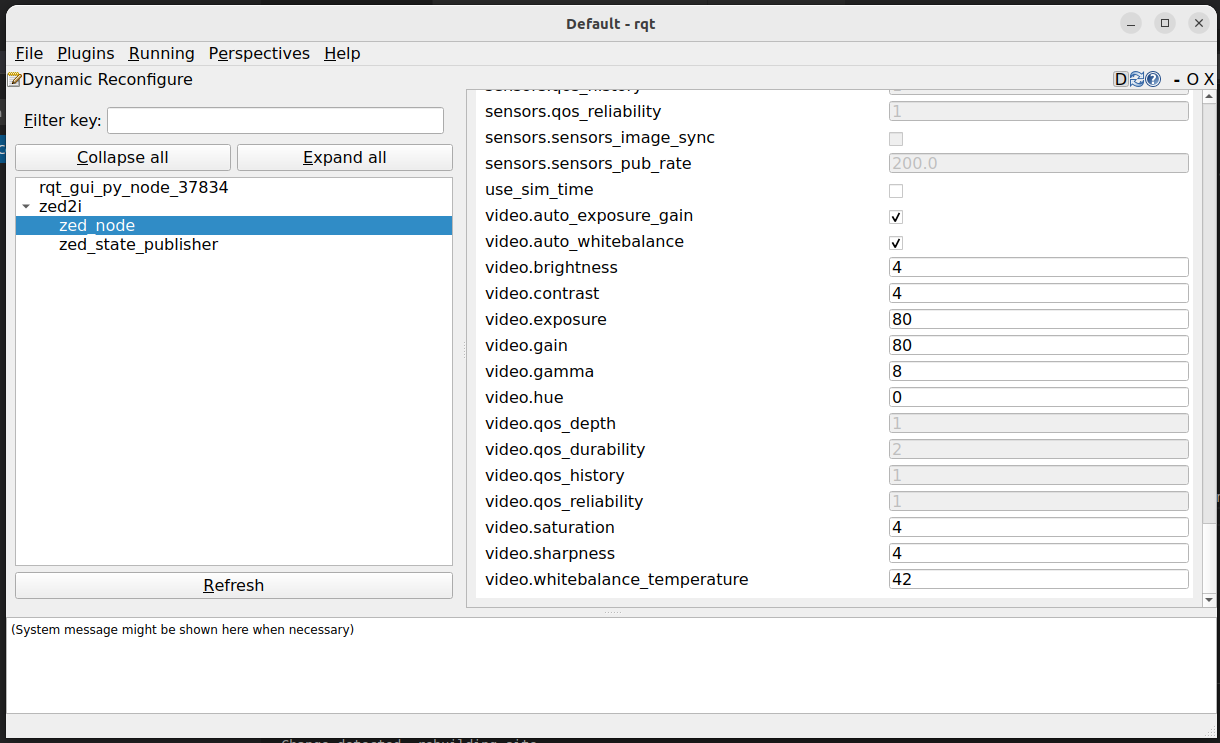
You can also use the Configuration -> Dynamic Reconfigure plugin of the rqt tool to dynamically set parameters by using a graphic interface.
Transform frames
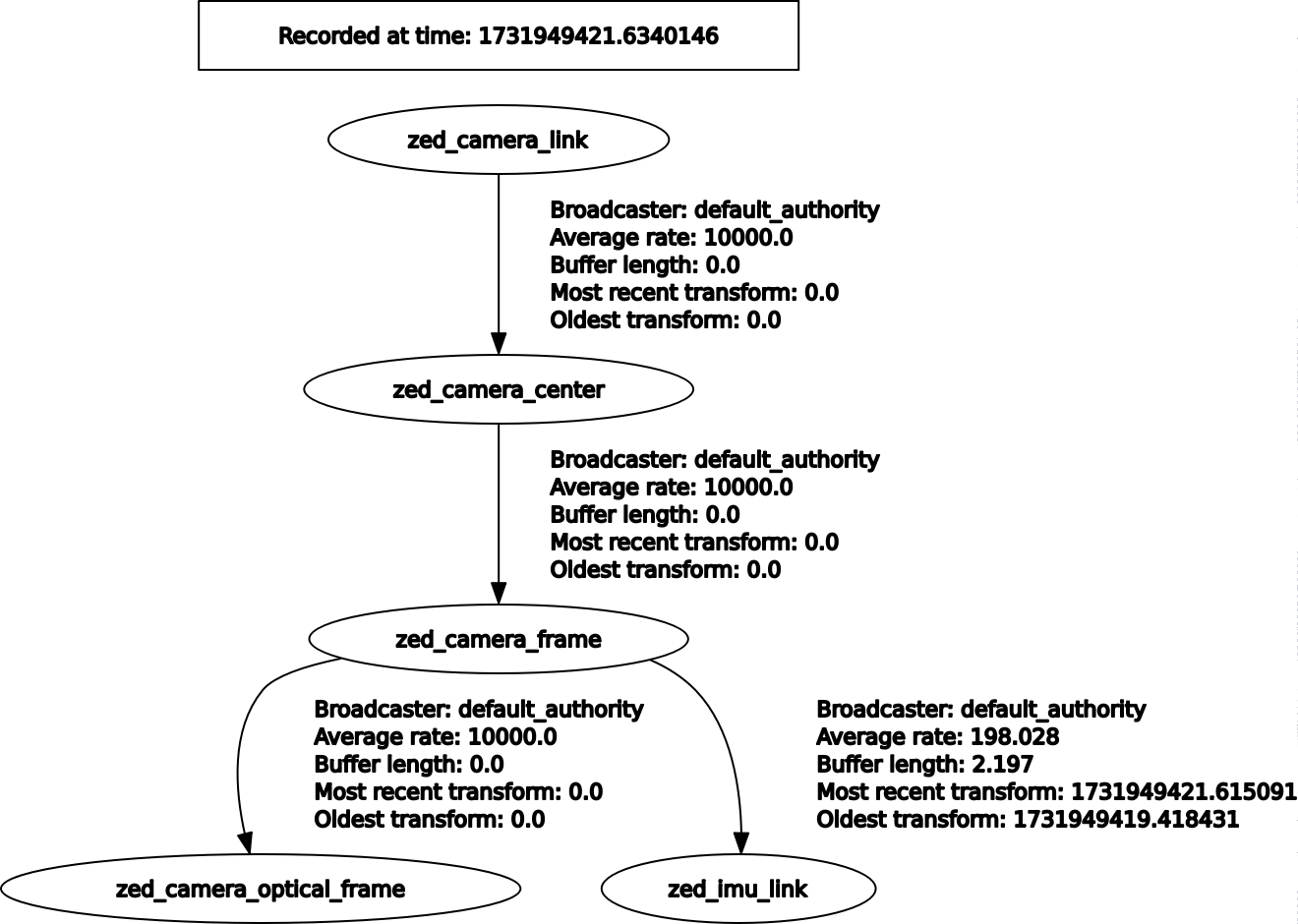
The ZED ROS 2 wrapper broadcasts multiple coordinate frames that each provides information about the camera’s position and orientation. If needed, the reference frames can be changed in the launch file.
<camera_name>_camera_linkis the current position and orientation of the ZED base center. It corresponds to the bottom central fixing hole.<camera_name>_camera_centeris the current position and orientation of ZED middle baseline, determined by visual odometry and the tracking module.<camera_name>_camera_frameis the position and orientation of the ZED’s CMOS sensor.<camera_name>_camera_frame_opticalis the position and orientation of the ZED’s camera optical frame.<camera_name>_imu_linkis the origin of the inertial data frame (not available with ZED).
Services
The ZED node provides the following services:
~/enable_streaming(std_srvs/srv/SetBool): enable/disable a local streaming server.~/start_svo_rec(zed_msgs/srv/StartSvoRec): Start recording an SVO file. If no filename is provided the default zed.svo is used. If no path is provided with the filename the default recording folder is ~/.ros/~/stop_svo_rec(std_srvs/srv/Trigger): Stop an active SVO recording.~/pause_svo_rec(std_srvs/srv/SetBool): Pause (data: true) and resume (data: false) an active SVO recording without closing the file. It returnssuccess: falsewhen no recording is active, and the diagnostic reportsSVO Recording: PAUSEDwhile paused.~/toggle_svo_pause(std_srvs/srv/Trigger): set/reset SVO playing pause. Note: Only available ifsvo.svo_realtimeis false and if an SVO has been chosen as input source.~/set_svo_frame(zed_msgs/srv/SetSvoFrame): Set the SVO playback frame to the specified value. Note: Only available if an SVO has been chosen as input source.
Services can be called using the rqt graphical tool by enabling the plugin Plugins -> Services -> Service caller.
It is possible to call a service also by using the CLI command ros2 service call.
For example, to start the local streaming server:
and the service server will reply:
Assigning a GPU to a camera
To improve performance, you can specify the gpu_id of the graphic card that will be used for the image processing in the common_mono.yaml configuration file. The default value (-1) will select the GPU with the highest number of CUDA cores. When using multiple cameras, you can assign each camera to a GPU to increase performance.
Node Diagnostic
The ZED ROS 2 node publishes useful diagnostic information aggregated into the /diagnostics topic using the diagnostic_updater package.
Diagnostic information can be analyzed and parsed by using ROS 2 tools, like for example the Runtime Monitor plugin of rqt.
Available information:
- Uptime
- Grab frequency and processing time
- Frame drop rate
- Input mode
- Image publishing rate and processing time
- IMU TF broadcasting rate
- IMU data publishing rate
- Camera internal temperature
- Scene Illuminance
- SVO playback status
- SVO recording status, including the
PAUSEDstate - Streaming server status