

ZED X One Specifications
This page gathers the hardware specifications of the ZED X One GS, ZED X One 4K and ZED X One S monocular cameras. The reference documents are the official ZED X One datasheets.
For the barebone MIPI version of the camera, see the ZED X One Core specifications.
Image sensor
The ZED X One GS and ZED X One S are built around an AR0234 1/2.6” 2.3 MP RGB global shutter sensor, which provides good low-light capabilities and distortion-free images of fast-moving objects. The ZED X One 4K uses a 1/1.8” 8.4 MP rolling shutter sensor with HDR technology, for applications that require maximum visual detail.
All three models support hardware synchronization of multiple cameras (see Multi-camera synchronization).
Optics
ZED X One GS and ZED X One S lens options
The IP69K rating of the ZED X One S applies to the Wide lens model only.
ZED X One 4K optics
Infrared cut filter
Every ZED X One lens includes an infrared (IR) cut filter: a thin glass plate with an optical coating that transmits visible light and blocks the near-infrared (NIR) and ultraviolet (UV) light that the human eye cannot see. The filter is part of the lens assembly and cannot be removed.
Why the filter is needed
The silicon image sensors of ZED X One cameras are sensitive to light from about 350 nm to 1100 nm, well beyond the visible range of about 400 nm to 700 nm. The red, green and blue color filters on the sensor pixels become almost transparent in the near infrared, so without an IR cut filter, NIR light would add unwanted signal to all three color channels:
- Washed-out and wrong colors: vegetation, dark fabrics and some plastics strongly reflect NIR and would look reddish or pink, and the whole image would lose saturation.
- Unstable white balance: the amount of NIR varies a lot between sunlight, incandescent lamps and LED lighting, so the same scene would look different under each light source.
- Softer images: lenses do not focus NIR light at the same distance as visible light, which blurs fine details.
By keeping only the visible band, the filter provides natural colors that are consistent from one camera to another, which also benefits computer vision and AI models.
Consequences for your application
- The cameras do not see near-infrared light. IR illuminators (typically 850 nm or 940 nm), the IR LEDs of surveillance cameras and the patterns projected by active depth cameras are almost invisible to them. Operation in the dark requires visible lighting.
- No interference from active IR sensors. For the same reason, LiDARs, time-of-flight cameras and structured light projectors operating nearby in the near infrared do not disturb the images.
Specifications
The table shows the filter’s transmission as a function of wavelength across the visible, UV and infrared ranges. T is the transmission at a given wavelength and Tavg the average transmission over a band.
The values of the ZED X One GS and ZED X One S Wide lens and of the ZED X One 4K are measured on a sample of their 650 nm IR cut filter, for which the supplier does not specify tolerances.
Motion sensor
All three models integrate a BOSCH BMI088 IMU, a high-performance 6-axis inertial sensor with a 16-bit triaxial accelerometer and gyroscope, providing orientation and motion detection of the camera. Its high vibration robustness and temperature stability make it suitable for harsh industrial robotics environments.
You can access the sensor data through the Sensors API of the ZED SDK.
Sensor positions
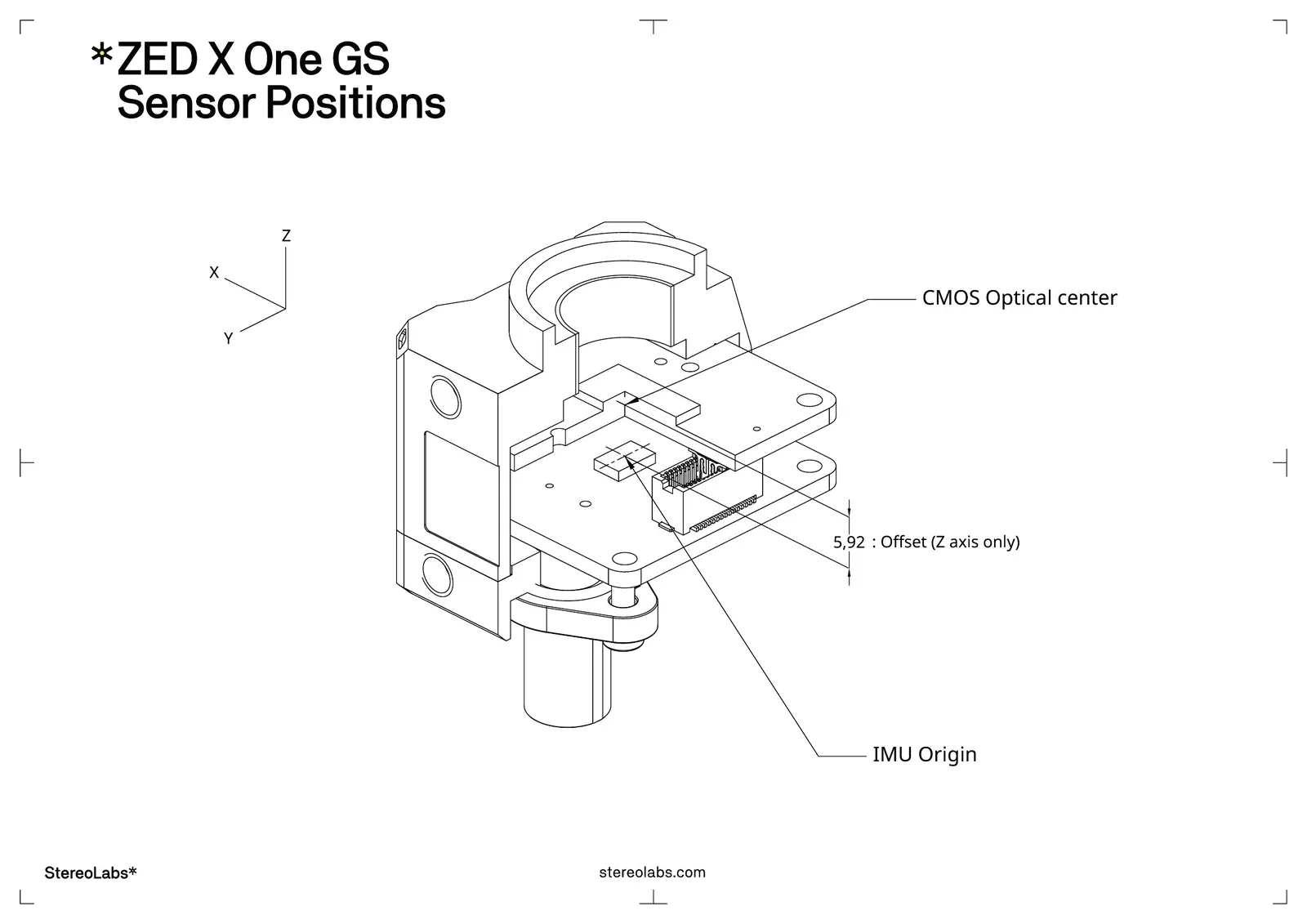
The offset values specify the location of the IMU origin with respect to the center of the image plane.
ZED X One GS
ZED X One 4K
ZED X One S
For the ZED X One 4K, the image plane to glass cover distance is 1.03 mm and the sensor thickness is 1.95 mm.
Multi-camera synchronization
All cameras connected to the same GMSL2 deserializer are automatically hardware-synchronized at frame level, within 15 µs. No wiring or configuration is required.
To synchronize cameras connected to different capture cards or devices, or to synchronize them with external sensors, use the hardware triggering options of your GMSL2 host:
- ZED Link Mono GPIO triggering
- ZED Link Duo GPIO triggering
- ZED Link Quad GPIO triggering
- ZED Box Mini multi-device synchronization
- ZED Box 2 multi-device synchronization
For hardware recommendations, synchronization methods, and local network streaming with multiple cameras, see the Multi-Camera page.
Physical specifications
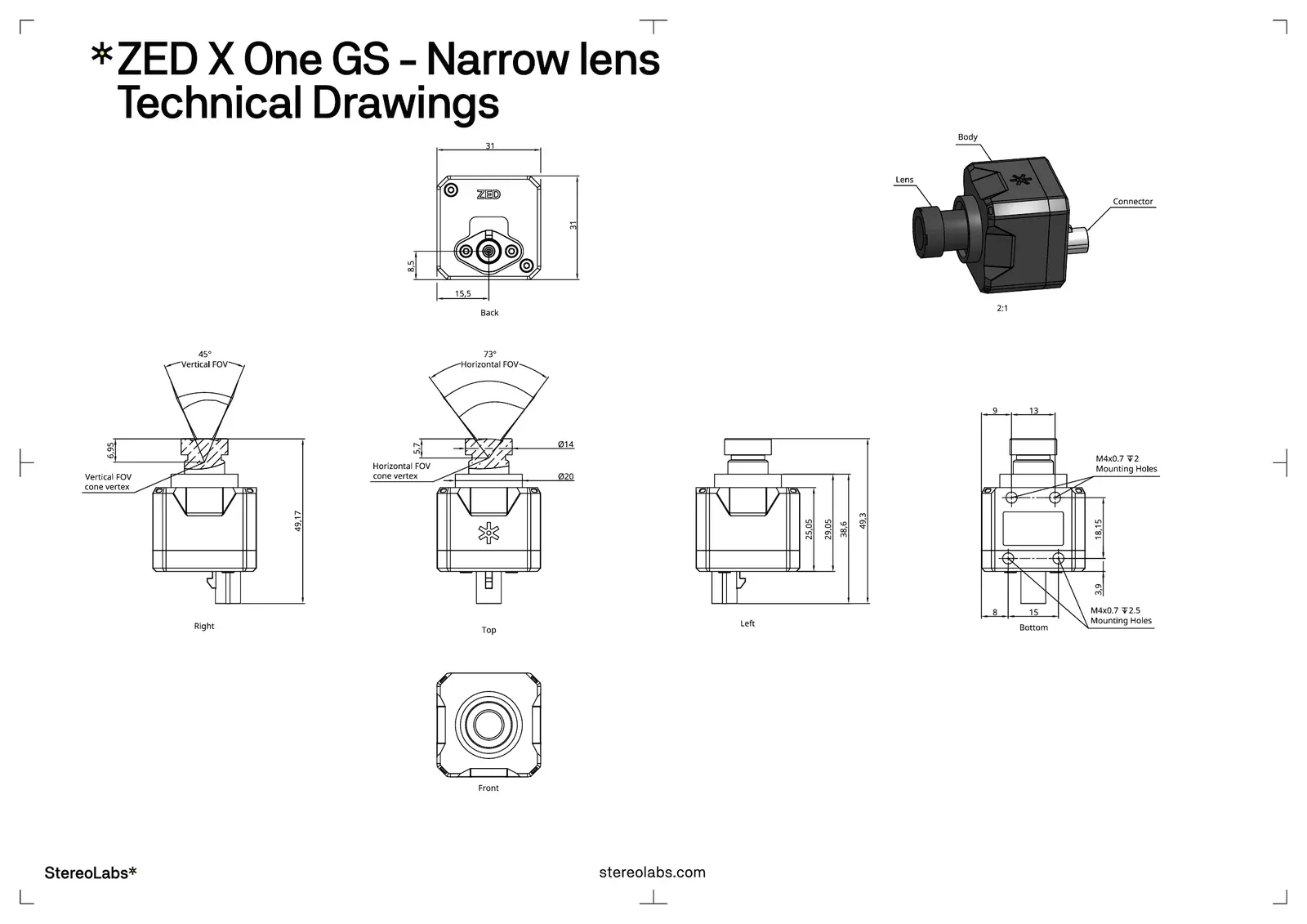
Technical drawings
ZED X One GS - Narrow lens
ZED X One GS - Wide lens
ZED X One 4K - Wide lens
ZED X One S - Narrow lens
ZED X One S - Wide lens
ZED X One S - Fisheye lens
System requirements
The ZED X One cameras require an NVIDIA® Jetson™ host equipped with a ZED Link Mono, Duo or Quad capture card for their GMSL2 connection. See the Recommended Specifications for ZED SDK page for the up-to-date host requirements.
On a ZED Link Quad capture card, up to 8 ZED X One GS or ZED X One S cameras can be captured at 1920x1200 @30 fps, or up to 4 ZED X One 4K cameras at 3840x2160 @15 fps.
Minimum ZED SDK version
Part numbers
Standards and compliance
The compliance certificates are available on the StereoLabs certificates page.