

ZED Box 2 Max
Congratulations on being the owner of a brand-new ZED Box 2 Max embedded PC!
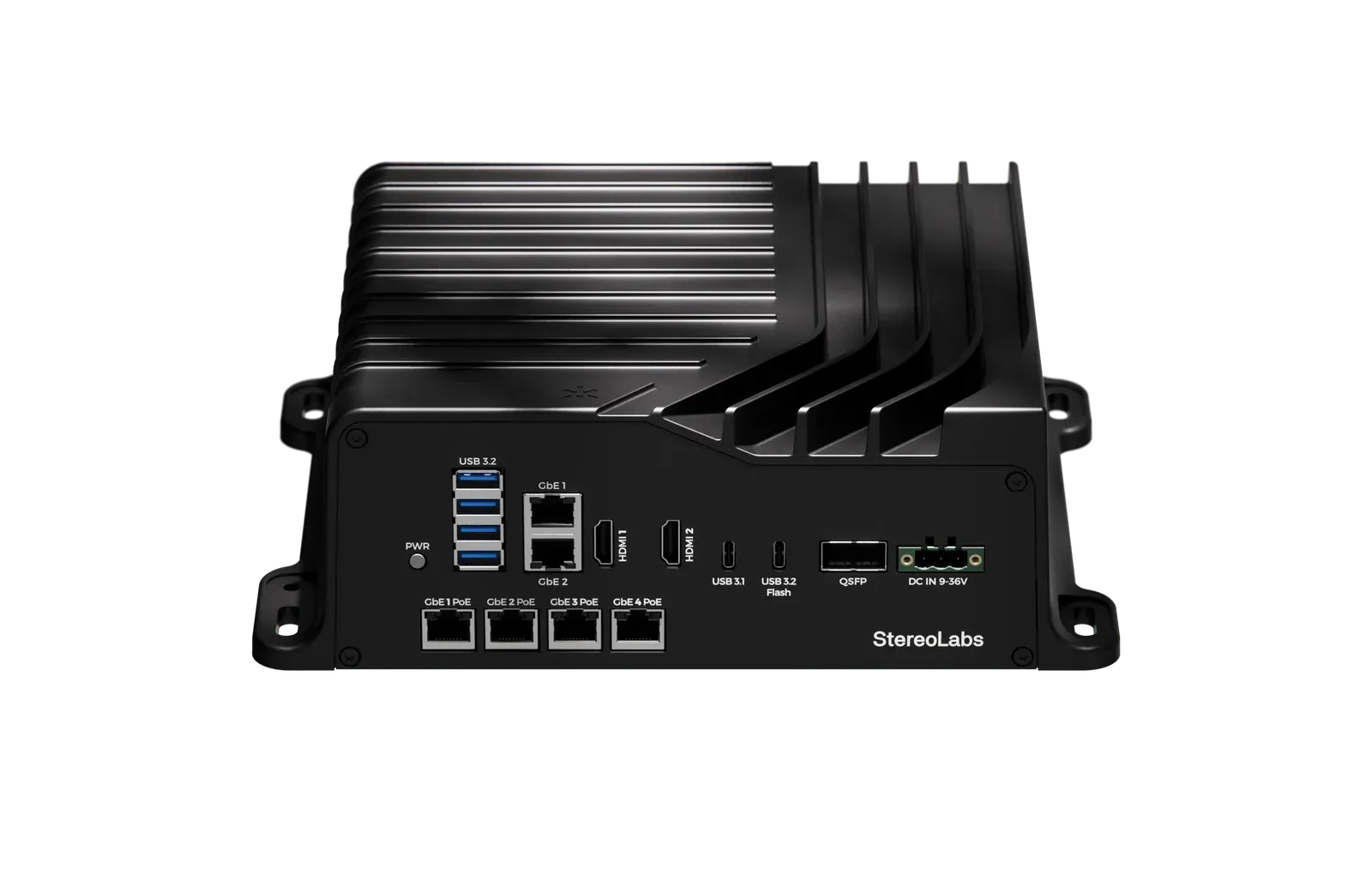
StereoLabs’ ZED Box 2 Max, available with the Jetson T4000 or the Jetson T5000 module, is a high-performance edge AI computer powered by the NVIDIA® Jetson Thor™ platform. It delivers up to 2070 FP4 TFLOPS of AI performance with up to 128 GB of memory, and combines 8 GMSL2 camera inputs, a QSFP+ port with up to 4x 10 GbE links, optional PoE+ ports, and extensive expansion options. It is designed for humanoid robotics, advanced autonomous machines, and demanding multi-sensor edge AI deployments.
The ZED Box 2 Max was previously announced as ZED Box 2 Thor.
Main features
The ZED Box 2 Max is a ready-to-use edge AI system: an NVIDIA® Jetson Thor™ compute module, 8 native GMSL2 camera inputs, and a high-density I/O panel in an actively cooled industrial aluminum enclosure.
Compute module
The ZED Box 2 Max is available with two NVIDIA® Jetson Thor™ compute modules, so you can match the computing power to the requirements of your application:
The GPU supports Multi-Instance GPU (MIG): you can split it into isolated instances with dedicated compute and memory, for example to run perception, navigation, and language models side by side with guaranteed resources. Read the Power Modes guide to select the mode that fits your application.
GMSL2 camera connectivity
GMSL2 connectivity is a standard feature of the ZED Box 2 Max. It enables high-speed, low-latency, hardware-synchronized data transfer between the processing unit and your ZED GMSL2 cameras.
- 8 GMSL2 ports on two Quad FAKRA-Z connectors, 4 ports each. Two GMSL2 FAKRA 1-to-4 cables are included.
- Compatible with the ZED X stereo cameras and the ZED X One monocular cameras, which can be combined.
- The GMSL2 driver is pre-installed. Connect the cameras before powering on the device: GMSL2 cameras are not hot-pluggable.
The Using GMSL guide describes how to set up your cameras.
Connectivity
The connection ports are available on the front and rear panels, described in the Connectivity guide:
- 2x Quad GMSL2 FAKRA-Z camera connectors
- 1x QSFP+ port: 4x 10 GbE on the T5000, 3x 10 GbE on the T4000
- 2x Gigabit Ethernet RJ45 (10/100/1000 Base-T)
- 4x Gigabit Ethernet RJ45 with PoE+ (optional)
- 4x USB 3.2 Type-A (2x 10 Gbps, 2x 5 Gbps)
- 1x USB 3.2 Type-C, also used for system flashing
- 1x USB 3.1 Type-C with USB Power Delivery input
- 1x USB 2.0 Type-C debug port for serial console access
- 2x HDMI 2.0
- 1x Expansion I/O connector: 4x CAN FD (T5000 only), UART, I2C, 5V and 3.3V power rails
- 2x 3.5 mm audio jacks: microphone input and line output
- 2x SIM card slots for an optional 4G/5G module
- WiFi 6 (Intel AX210 module) with 2x external antennas
- Power and Recovery buttons
Storage memory
An internal M.2 NVMe SSD hosts the operating system and your data. Three capacities are available:
- 256 GB
- 1 TB
- 2 TB
On models without the PoE+ option, a second M.2 Key M 2280 slot (PCIe Gen4 x2) can host an additional NVMe SSD, for example for long data-collection runs. Installing it requires opening the enclosure: contact support@stereolabs.com before doing so.
Power supply
The ZED Box 2 Max can be powered in two ways:
- DC terminal block (9V to 36V, 10A max), with the provided power supply: supports all the power modes and the PoE+ option.
- USB Type-C Power Delivery (9V to 28V, 40W to 130W): does not support the PoE+ option, nor the 120W and MAXN power modes of the T5000. This power input is not recommended for now: use the DC terminal block.
The maximum power consumption of the whole system is 250W. Only one power input is active at a time: the first source connected is used. See the Connectivity guide for the pinout.
Cooling
The ZED Box 2 Max features an actively cooled industrial aluminum enclosure, with an integrated heatsink and fan, to sustain the highest power modes of the Jetson Thor™ module.
Software
The ZED Box 2 Max is shipped with a pre-configured operating system, including the NVIDIA® JetPack™ 7 software stack, the ZED SDK, and the GMSL2 drivers, so it is operational out of the box. It supports ROS 2 and Isaac ROS. Flashing is only required to change the JetPack version or to recover the device. The flashing guide, with updated flash scripts, will be available soon.
Options
In addition to the features above, the ZED Box 2 Max can be configured with the following options, based on your specific needs and use cases.
PoE+ Option
With the PoE+ option, the ZED Box 2 Max provides 4 additional Gigabit Ethernet ports that power the connected devices, such as lidars or IP cameras, according to the IEEE 802.3at (PoE+) standard, with up to 25W per port. Cameras and networked sensors connect directly, with no external switches or injectors.
GNSS Option
With the GNSS option, the ZED Box 2 Max integrates a dual-antenna RTK GNSS receiver, multiband L1/L2/L5, for centimeter-level positioning. Two multiband GNSS antennas are included, to connect to the SMA connectors on the rear panel. The GNSS data can be fused with the ZED cameras by the ZED SDK Global Localization module.
4G/5G cellular connectivity
The two SIM card slots allow the connection of the ZED Box 2 Max to 4G/LTE and 5G cellular networks, with an additional M.2 cellular module.
The 4G/5G module, its SMA connectors, and its antennas are not included. Installing them requires opening the enclosure: contact support@stereolabs.com before doing so.
Specifications
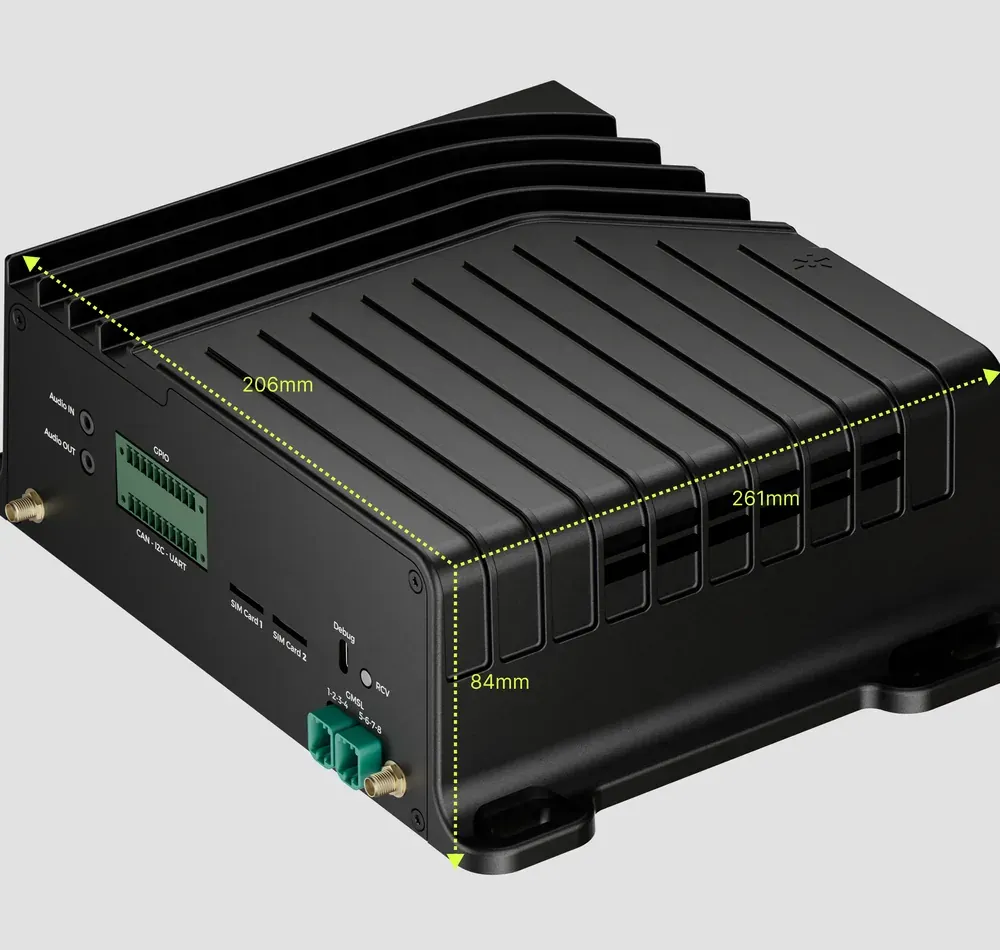
Part numbers
The part number identifies the module, the storage capacity, and the options: ZBX-7MGSSP, where M is the module (1 = T4000, 2 = T5000), G the GNSS option (0 = no, 1 = yes), SS the storage (11 = 256 GB, 12 = 1 TB, 13 = 2 TB), and P the PoE+ option (0 = no, 1 = yes).
Hardware reference
- Datasheets - the ZED Box 2 Max datasheet, with the technical drawings of the enclosure.
- CAD Files - the most up-to-date CAD files of all our products.