

ZED X Specifications
This page gathers the hardware specifications of the ZED X, ZED X Mini and ZED X Nano GMSL2 stereo cameras. The reference documents are the official ZED X / ZED X Mini and ZED X Nano datasheets.
Image sensors
The three cameras share the same dual 1/2.6” 2.3 MP RGB global shutter sensors, which provide good low-light capabilities and distortion-free images of fast-moving objects.
Depth sensing
Depth is computed by the ZED SDK Depth Sensing module using the Neural Depth Engine.
Optics
ZED X and ZED X Mini lens options
The ZED X and ZED X Mini use a wide-angle 9-element all-glass dual lens with optically corrected distortion. Both lens options are also available with a built-in polarizing filter.
ZED X Nano optics
The ZED X Nano uses a fixed 6-element hybrid dual lens.
Polarizing filter option
Both ZED X and ZED X Mini lens options can be ordered with a built-in polarizing filter in front of the lenses. The filter cannot be added or removed later: it is part of the camera configuration and has its own part number. The ZED X Nano is not available with a polarizer. This section explains what the filter does and helps you decide whether your application needs it.
The same outdoor scene with and without a polarizing filter. The polarized side of the sliding split shows a deeper blue sky, less glare on the asphalt and more saturated colors.
How it works
When sunlight reflects off non-metallic surfaces such as water, glass, wet asphalt, painted car bodies, plastic or glossy leaves, the reflected light becomes partially polarized. The polarizing filter blocks a large part of this polarized light while letting through the light that carries the actual texture of the scene. Light scattered by the blue sky is also partially polarized, so the filter darkens the sky and reduces atmospheric haze.
This matters for stereo vision because specular reflections and glare depend on the point of view: the same highlight appears at a different position in the left and right images, or in only one of them. Stereo matching then struggles to find consistent correspondences, resulting in holes, noise or wrong depth values on reflective surfaces. By removing most of these reflections, the filter makes the left and right images more consistent and the depth more reliable.
Advantages outdoors in sunlight
- Fewer reflections and less glare on water, windows, glass facades, wet roads, vehicles and other glossy surfaces, and therefore fewer depth artifacts and false detections in these areas.
- Better contrast and color saturation, with a less washed-out sky and less haze. The auto exposure can more easily preserve detail in both the sky and the ground.
- No practical cost from the light loss: in direct sunlight, the scene is bright enough for the camera to keep short exposure times and low gain even with the filter.
Disadvantages indoors and in low light
A polarizing filter also absorbs unpolarized light: it typically blocks half to two thirds of the incoming light, which corresponds to 1 to 1.5 stops. Indoors, where light levels are often hundreds of times lower than in daylight, this loss has visible consequences:
- Longer exposure times are needed to reach the same image brightness, which increases motion blur when the camera or objects move. The exposure time is also capped by the frame rate (about 33 ms at 30 FPS, 17 ms at 60 FPS and 8 ms at 120 FPS), so in dim scenes the camera quickly reaches this cap.
- Higher gain and more image noise: once the exposure time is at its maximum, the auto exposure compensates by raising the gain. Noise and blur degrade the depth (more noise, lower confidence, fewer valid pixels) and reduce the number of reliable visual features available to positional tracking, object detection and body tracking.
- Little benefit in return: artificial light is mostly unpolarized and indoor reflections are much weaker than sunlight glare, so the filter has little to remove.
- Screens can appear dark: most LCD and OLED displays emit polarized light. Depending on how the screen is oriented relative to the camera, monitors, phones or control panels can look dim or completely black through the filter.
Other points to consider
- The filter orientation is fixed. Unlike a photographic polarizer, it cannot be rotated to tune the effect, so its efficiency depends on the scene geometry. The effect is strongest on reflections seen at a grazing angle (around 30° to 40° above the reflecting surface) and on the part of the sky at about 90° from the sun. If you mount the camera rolled (for example vertically), the filter rotates with it and reduces reflections differently.
- Reflections from bare metal are not removed, because they are not polarized.
- Uneven sky with wide lenses: sky polarization varies with the direction relative to the sun, so with a wide field of view the sky can look unevenly darkened across the image. This effect is cosmetic and does not affect depth.
- Stress patterns: when the camera looks through tempered glass, a windshield or transparent plastic (for example a protective window in front of the camera), the filter can reveal rainbow or mottled patterns caused by internal stress in the material.
Should you choose the polarizer?
As a rule of thumb, choose the polarizer when the camera works mainly outdoors in daylight and reflections are a concern. For indoor, low-light or mixed setups, collecting as much light as possible usually matters more, so choose the version without a polarizer.
If you are unsure, record SVO files of your real scenes. Check the depth map on reflective surfaces, then check the exposure and gain values reported by the camera controls in your darkest conditions. A high gain, or an exposure time close to the frame period, means the scene is too dark for a polarizer.
Motion sensor
All three cameras integrate a high-performance 6-axis inertial sensor with a 16-bit triaxial accelerometer and gyroscope, providing orientation and motion detection of the camera. Its high vibration robustness and temperature stability make it suitable for harsh industrial robotics environments.
You can access the sensor data through the Sensors API of the ZED SDK.
The ZED X and ZED X Mini also embed a TMP102 temperature sensor on the internal I2C bus.
Positional tracking
Physical specifications
Only the ZED X and ZED X Mini are IP67 rated. The ZED X Nano has no IP rating and is designed for indoor use.
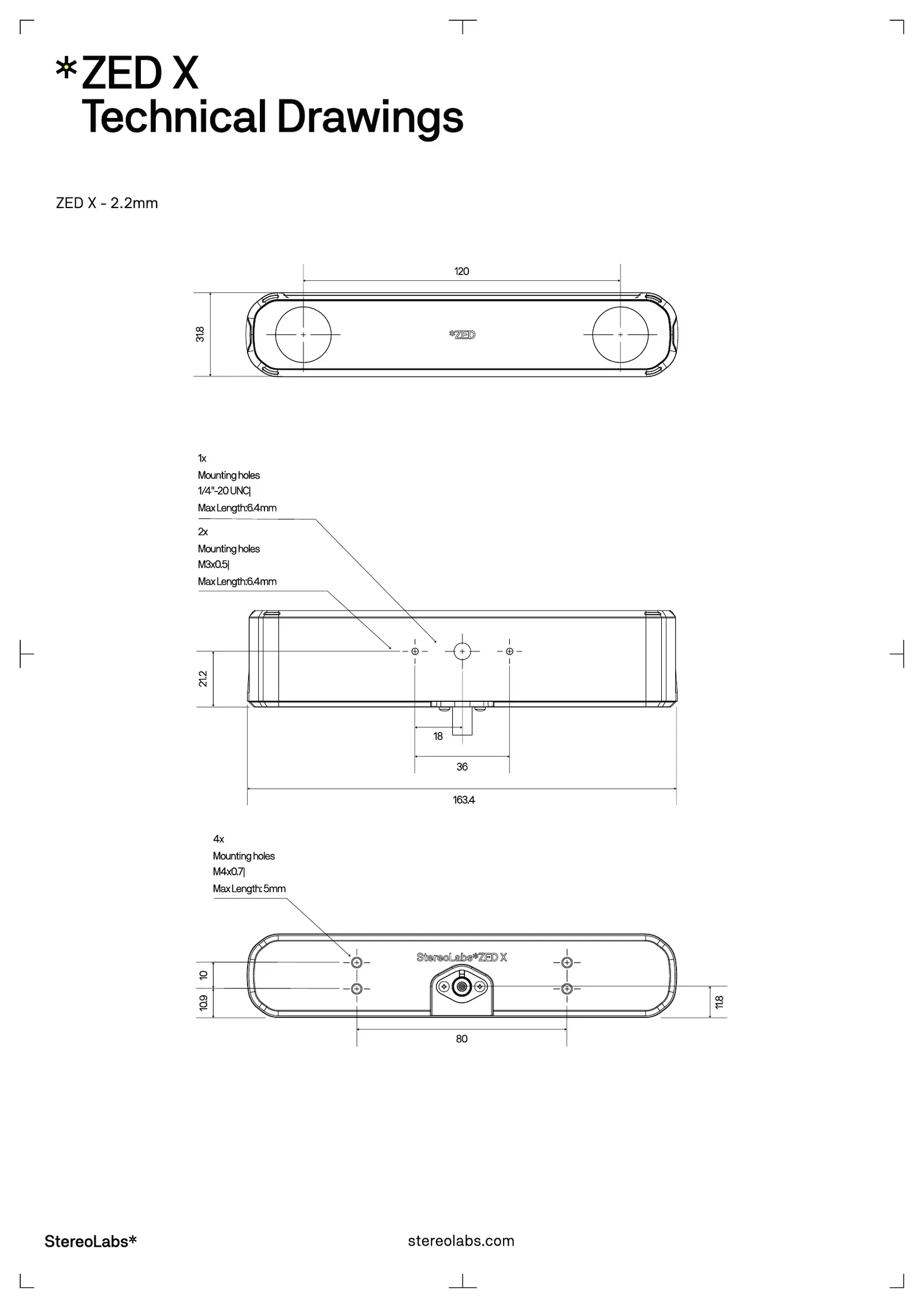
Technical drawings
ZED X - Wide lens
ZED X - Narrow lens
ZED X Mini - Wide lens
ZED X Mini - Narrow lens
ZED X Nano
System requirements
The ZED X, ZED X Mini and ZED X Nano require an NVIDIA® Jetson™ host equipped with a ZED Link Mono, Duo or Quad capture card for their GMSL2 connection. See the Recommended Specifications for ZED SDK page for the up-to-date host requirements.
Minimum ZED SDK version
Part numbers
Standards and compliance
The compliance list of the ZED X Nano is not published in its datasheet yet. Refer to the StereoLabs certificates page for its up-to-date status.
The compliance certificates are available on the StereoLabs certificates page.